
SEO Tips: A High-Quality, Practical Guide to Ranking in 2025
This is a practical, step-by-step playbook for modern search engine optimisation — from research and technical fixes to content strategy and link building. Use these tips to craft an evergreen SEO programme that improves visibility, traffic and conversions.
Introduction — Why SEO Still Matters in 2025
Search engine optimisation is both art and science. Over the last decade search has evolved from simple keyword matching to multifaceted algorithms that evaluate topical authority, user satisfaction, intent alignment and page experience. In 2025, SEO success depends on a combination of technical excellence, authoritative content and a disciplined measurement culture. This guide gives you the tactical playbook to plan, execute and measure an SEO programme that scales.
We avoid fluffy theory and provide practical steps you can apply immediately. Whether you manage a personal blog, run an agency, or lead SEO for an enterprise, these best practices will help you structure your work, prioritise high-impact tasks and avoid common pitfalls. Read on for research techniques, on-page optimisation, structured data, speed and Core Web Vitals, content frameworks, link acquisition strategies, and advanced measurement approaches.
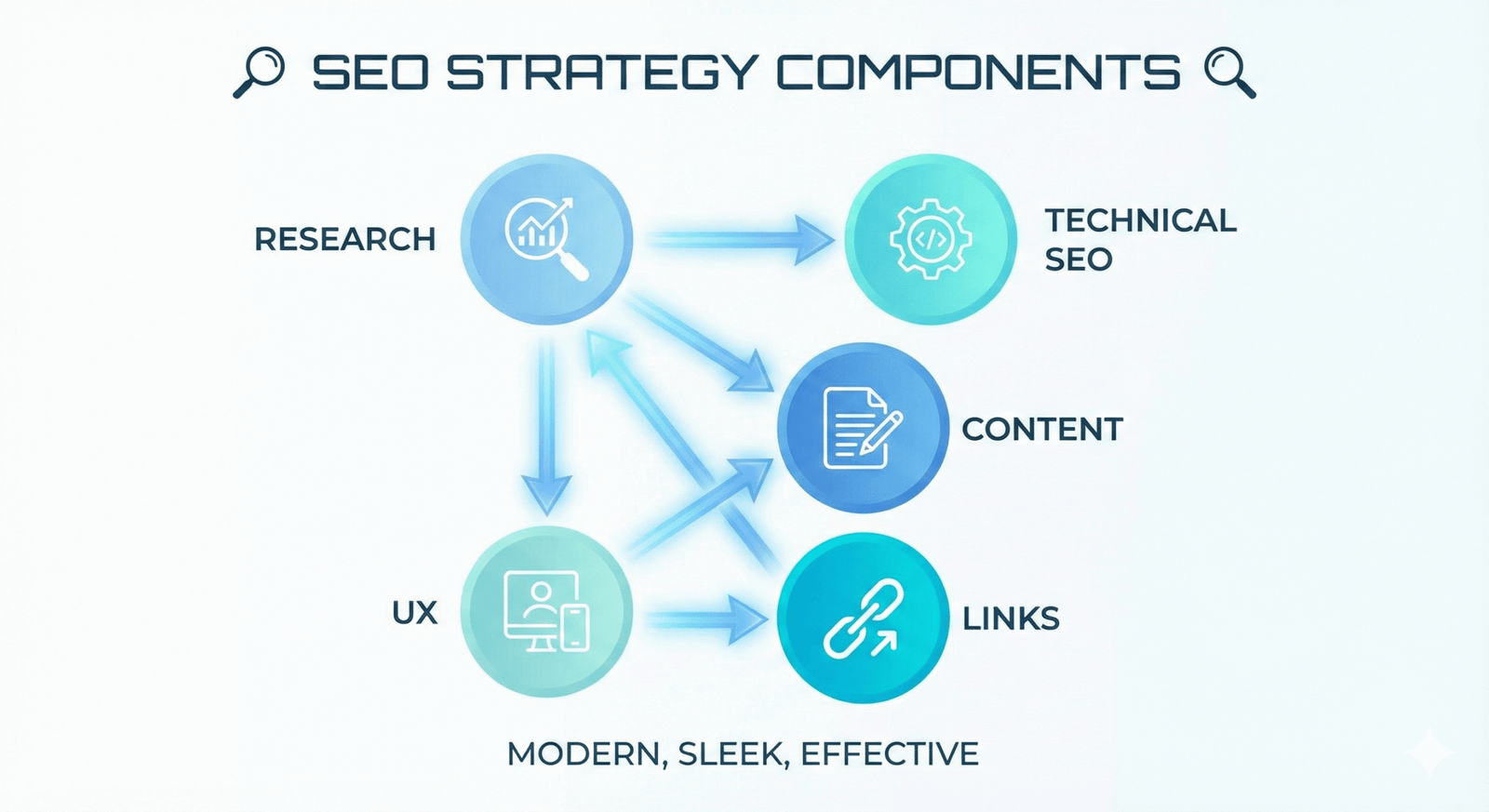
Core Principles: What Modern SEO Prioritises
Before entering tactical steps, internalise these guiding principles. They will help you choose which tasks to prioritise and why.
1. User intent trumps keywords
Search engines want to satisfy users. Keywords matter, but intent — whether informational, navigational or transactional — drives performance. When you map content to intent correctly, you increase dwell time, reduce pogo-sticking and improve rankings.
2. Topical depth & semantic coverage
Modern ranking is influenced by how comprehensively a page (and site) covers a topic. Focus on topic clusters: a pillar page supported by related posts that link together. Use tools that surface semantically related terms and natural language concepts and try to cover subtopics exhaustively.
3. Page experience & Core Web Vitals
Loading speed, interactivity and visual stability remain ranking factors. Site performance affects both SEO and conversion; a fast, stable site improves perceived quality and reduces bounce rates.
4. Structured data and clarity
Use structured markup (schema.org) to describe content. Structured data helps search engines understand content type — product, article, FAQ, recipe — and enables rich results that increase click-through rates.
5. Measurement and iterative improvement
SEO is iterative. Measure rankings, traffic quality and user behaviour. Use experiments — A/B tests for meta titles, content structure or internal linking — and scale strategies that demonstrably improve KPI metrics.
Keyword Research & Topic Selection — The Right Way
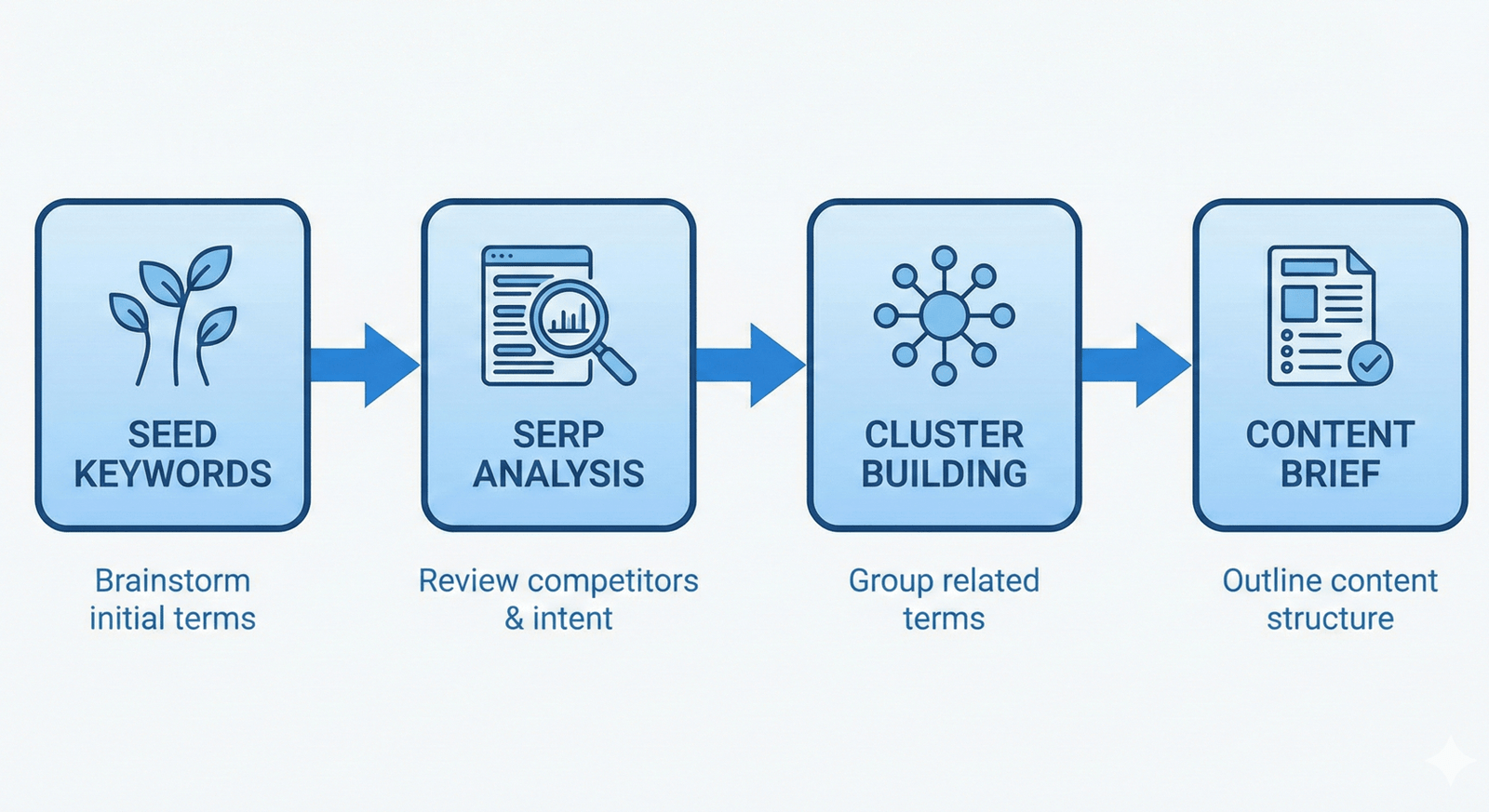
Keyword research in 2025 is about understanding audience needs and constructing topic clusters. Follow these steps to choose high-impact topics that match your audience and business goals.
Step 1 — Start with business intent
Map keywords to commercial goals: awareness (top-of-funnel), consideration (mid-funnel) and conversion (bottom-of-funnel). Prioritise topics that align with revenue or strategic objectives. For example, a SaaS company might prioritise “how to choose X software” (consideration) over purely informational topics if trials convert at higher rates.
Step 2 — Use a combination of tools
Don’t rely on a single keyword tool. Use a blend: an SEO platform (Surfer, Ahrefs, Semrush), Google Search Console for existing queries, and generative tools for ideation. Cross-reference monthly volume, keyword difficulty and SERP features (e.g., featured snippets, People Also Ask).
Step 3 — Evaluate SERP intent and competition
Before committing, inspect the current top 10 results for your target query. Are they listicles, product pages, or long-form guides? If the SERP shows product pages, a purely informational article may struggle to rank without a different angle. Also gauge content length, backlinks and topical breadth required to compete.
Step 4 — Build topic clusters
Create pillar pages that give comprehensive overviews and link to supporting posts that delve into subtopics. This structure signals topical authority and improves internal linking flow. For example, a pillar on “AI writing tools” should link to reviews (Jasper, Copy.ai), how-to guides, and comparison articles.
Tools to use
Surfer SEO, Ahrefs, Semrush, Google Search Console, AnswerThePublic, KeywordTool, ChatGPT for ideation.
Checklist
Intent aligned, SERP analysed, topic cluster planned, prioritised by ROI.
Technical SEO — Foundation and Fortification
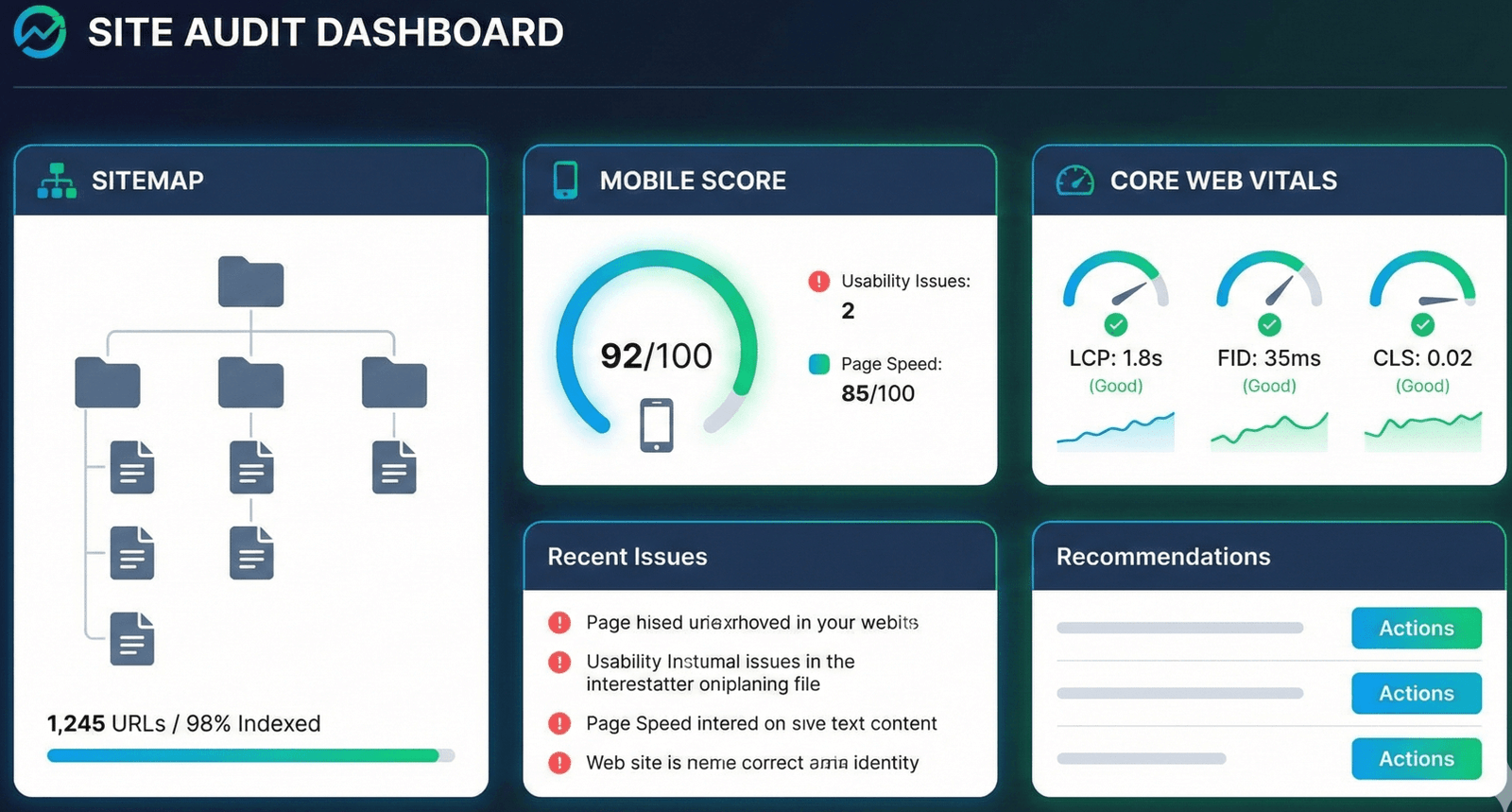
Technical SEO ensures search engines can find, crawl and index your content efficiently. It also underpins speed and reliability — both crucial for user experience. Below are high-impact technical tasks, ordered by priority.
1. Crawlability & indexability
Use Google Search Console, Screaming Frog or a site crawler to audit the site. Look for blocked resources, disallowed pages (robots.txt), and noindex tags. Ensure essential pages are not inadvertently blocked and that the XML sitemap is accurate and submitted to Search Console.
2. Canonicalisation & duplicate content
Set canonical tags on pages with similar content. Duplicate content dilutes ranking signals — use canonical tags or consolidate content. For e-commerce sites, canonicalise faceted navigation pages and ensure parameter handling is consistent.
3. URL structure & site architecture
Keep URLs short, readable and consistent. Prefer hyphens, avoid special parameters where possible and reflect site hierarchy semantically (e.g., /blog/seo-tips/). A shallow architecture — with important pages a few clicks from the homepage — helps search engines and users.
4. Mobile-first & responsive design
Google primarily indexes mobile versions. Test pages with Google’s Mobile-Friendly Test and fix layout issues, viewport settings, and touch targets. Ensure content parity between desktop and mobile.
5. Speed & Core Web Vitals
Pay attention to LCP (Largest Contentful Paint), FID / INP (interaction delay metrics) and CLS (layout shift). Optimise images (next-gen formats, responsive srcset), use lazy loading appropriately, minimise render-blocking scripts, and enable caching/CDN. Tools: Lighthouse, PageSpeed Insights, WebPageTest.
6. Secure site & HTTPS
Always serve pages over HTTPS. Renew certificates, enforce HSTS for added security, and ensure mixed content warnings are fixed.
7. Structured data
Add schema markup relevant to the page: Article, FAQ, HowTo, Product, BreadcrumbList. Structured data increases the chance of rich snippets and helps search engines understand the content context.
Technical audit checklist
- XML sitemap accuracy and submission
- Robots.txt correctness
- Noindex/canonical checks
- Mobile performance & responsive checks
- Core Web Vitals monitoring
- Structured data implementation and testing
Content Strategy & On-Page Optimisation
Content remains king — but the quality bar has risen. Here we provide a repeatable framework for high-quality pages that rank and convert.
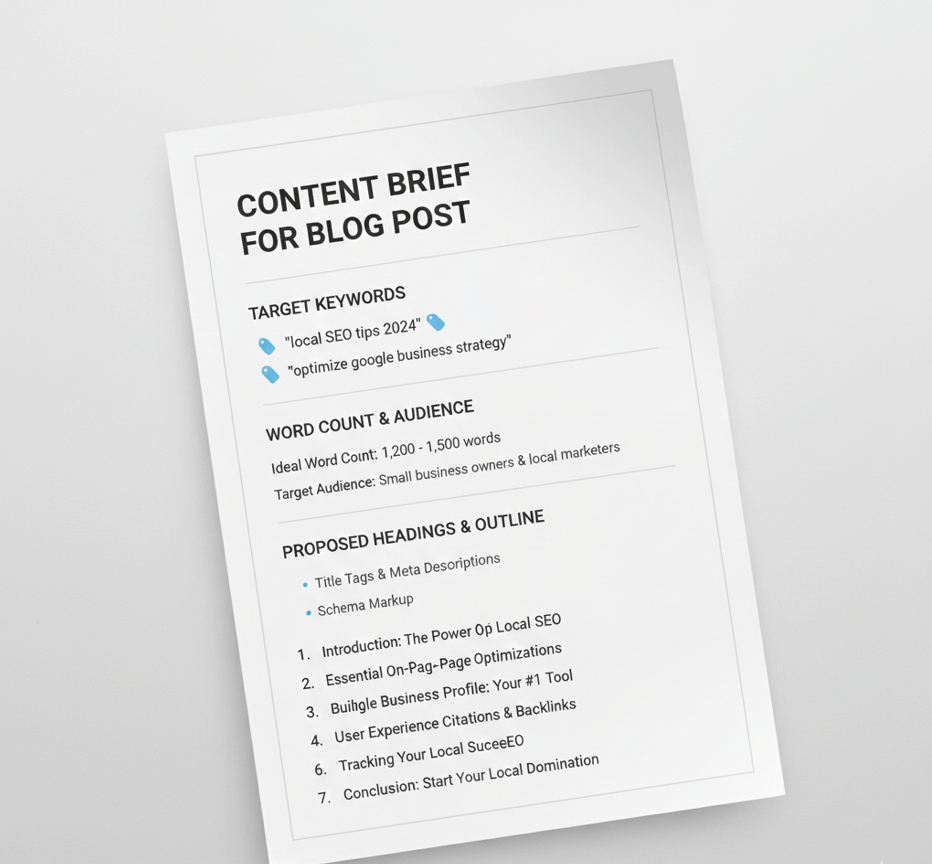
1. Content briefs that win
A strong brief saves time. A brief should include: target keyword and intent, target word count range, suggested headings (H2/H3 structure), primary and secondary keywords, target audience, examples of competing articles, and desired CTA. Use Surfer or similar to generate a data-driven brief automatically.
2. Opening that satisfies intent & reduces pogo-sticking
The first 200 words should immediately satisfy the user’s intent. If the query is informational, give a clear, succinct answer followed by an outline of what the article covers. This reduces bounce rates and improves dwell time.
3. Use headings for both users & search engines
Headings should be descriptive and include variations of target keywords naturally. They help readers scan and assist search engines in understanding structure.
4. Semantic keyword usage
Avoid keyword stuffing; instead, use related terms and natural synonyms across the page. Tools with NLP suggestions can help you include semantically relevant phrases that boost topical relevance.
5. Visuals and multimedia
Images, diagrams, video and interactive elements enrich the user experience and lengthen session duration. Always optimise images for size and accessibility (alt attributes). Captions and descriptive text improve context for both users and search engines.
6. Internal linking strategy
Use internal links to guide users through topic clusters and to distribute link equity. Link from high-authority pages to new or underperforming articles that you want to boost. Use descriptive anchor text (avoid “click here”).
7. Meta titles & descriptions
Write compelling meta titles that include the target keyword and a value proposition. Meta descriptions should summarise the page and include a call-to-action where appropriate; they influence click-throughs even if not a direct ranking factor.
On-page checklist
Brief, clear intro; H2/H3 structure; semantic keywords; optimised images; internal links; meta title & description.
Tools for writing
Surfer, Jasper, Writesonic, Grammarly, Hemingway, Clearscope (or equivalents).
Link Acquisition & Digital PR
Backlinks remain a crucial signal of authority. The modern link-building landscape emphasises relevance, editorial value and brand relationships.
1. Earned links through outstanding content
Create resources that others want to reference: original research, data-driven studies, comprehensive guides and unique tools. These assets attract organic editorial links and social shares.
2. Outreach with a personalised angle
Cold outreach works better when personalised and helpful. Reference a recent article by the recipient, propose how your content adds value, and avoid generic templates. Provide a concise reason for linking.
3. Digital PR and newsworthy campaigns
Leverage unique data, industry surveys or novel insights to gain media coverage. Outreach to journalists and resource pages can generate high-quality links and brand mentions.
4. Partnerships & guest contributions
Guest posting remains valuable when done on reputable sites in your niche. Focus on quality over quantity and pitch topics that are highly relevant to the target site’s audience.
5. Monitor & remove toxic links
Use backlink monitoring tools to identify spammy links. Disavow where appropriate, but first attempt removal via outreach if the links are harmful.
Link building checklist
- Create one high-value linkable asset per quarter
- Personalised outreach to relevant sites
- Monitor backlinks and disavow toxic links
- Track referral traffic and conversions from acquired links
Measurement, Reporting & Growth Loops
Make measurement a foundation of your SEO process. Without reliable metrics, optimisation becomes guesswork.
1. Core metrics to monitor
Track organic sessions, new users, landing page conversion rate, rankings for priority keywords, bounce rate, average session duration and pages per session. Segment by content cluster to understand impact.
2. Set up dashboards
Create dashboards in Google Data Studio / Looker Studio or your BI tool to visualise performance. Dashboards should show trends rather than raw numbers and highlight areas needing attention (drops, seasonal shifts, content decay).
3. Attribution & CRO integration
Connect SEO to conversion metrics. Use UTM tagging for campaign-driven content and integrate SEO reporting with conversion rate optimisation experiments to measure downstream impact.
4. Regular audits & decay remediation
Schedule quarterly content audits to identify decaying posts. Refresh, merge, or deprecate content based on performance. Prioritise updates where pages lost rankings due to outdated facts or broken links.
Suggested KPI targets
Initial: increase organic sessions by 10–20% in 3 months; longer term: 50%+ in 12 months for new content programmes (varies by baseline).
Tools for tracking
Google Analytics / GA4, Search Console, Ahrefs / Semrush, Looker Studio.
Advanced Topics: Trust, Local & Multilingual SEO
As you scale, focus on signals that reinforce trust and relevance: E-E-A-T (Experience, Expertise, Authoritativeness, Trustworthiness), localisation and multilingual strategies.
E-E-A-T and authoritativeness
Demonstrate subject matter expertise: author bios, credentials, citations and transparent editorial policies help. For YMYL (Your Money Your Life) pages, emphasize accuracy, expert review and robust sourcing.
Local SEO
For local businesses, claim and optimise Google Business Profile, maintain consistent NAP (name, address, phone) citations, encourage reviews and create locally focused content that targets neighbourhood- or city-level queries.
Multilingual & hreflang
When targeting multiple languages, implement hreflang correctly to avoid duplicate content and to serve the right language/region variant. Consider separate subdirectories (example.com/fr/) for clarity and better management.
International content strategy
Do not simply translate — localise. Adapt examples, pricing, measurements, and cultural references. Local link outreach and partnerships can accelerate local authority.
Actionable Checklist & 90-Day Roadmap
The following checklist and roadmap will help you operationalise the guidance above into a repeatable plan.
Immediate checklist (first 14 days)
- Run a technical crawl and fix critical indexability errors
- Submit XML sitemap to Search Console
- Identify 10 priority pages for optimisation
- Create content briefs for 4 new pillar/supporting articles
- Configure dashboards for key metrics
30–60 days
Complete first round of content production and publish initial pillars + supporting posts.
Begin outreach for at least one linkable asset; secure first backlinks.
Run A/B tests on meta titles and CTAs for high-traffic pages.
60–90 days
Audit published content and refresh underperformers.
Scale content production using templates and automation where safe.
Measure ROI and refine budget for tool seats and credits based on usage.